

The title I Want to Eat Your Pancreas (Kimi no Suizou wo Tabetai) may initially bring to mind either a grotesque horror premise or a bizarre clinical curiosity, however, within minutes, the 2018 animated film reveals itself to be a tragic exploration of mortality. The medium of digital animation and the contemporary Japanese highschool setting may be far apart from ancient Greece, but the film serves as a prime example for understanding classical theories of drama. By examining the film through the lens of Aristotle’s Poetics, written in the 4th century BC, we can see that the mechanics of achieving human emotion in drama have remained consistent. This essay will argue that film is an appropriate medium for Aristotelian tragedy. I Want to Eat Your Pancreas serves as a perfect example because it utilises modern spectacle, identified by Aristotle as a minor element of tragedy, to amplify the acts of recognition and reversal in the narrative, proving that Aristotle’s framework, which was made for theatre, can and is still used for tragedies told in newer visual mediums.
In Poetics, Aristotle posits that Mythos, or plot, is the ‘source’ and ‘soul of tragedy.’[1] He argues that tragedy is an imitation of action and of life, and that for a plot to be successful it must be a complete ‘whole’, consisting of ‘a beginning, a middle, and an end,’[2] governed by the laws of ‘probability or necessity.’[3]
I Want to Eat Your Pancreas adheres to this structure, yet it also controls the order that events are recounted to the audience to maximise their emotional effect. The film begins in media res at a funeral. We see the protagonist, Haruki, who is grieving in silence, and we learn that the female lead, Sakura, has died. By revealing the ending at the outset, the film establishes what Aristotle had identified as the most important effects that tragedy has: Pity and Fear. We feel pity for Sakura’s stolen youth and fear the inevitable march toward the funeral that we have witnessed.
Aristotle also emphasised the importance of peripeteia, or reversal, which is ‘a change to the opposite in the actions being performed’ but crucially, a change which should remain ‘in accordance with probability or necessity.’[4] Throughout the film, the audience and characters are led to believe that the ‘necessity’ of the tragic plot is dictated by Sakura’s terminal illness. We expect a slow, medical decline, however the film’s reversal occurs not when Sakura is claimed by her terminal disease, but rather by a sudden act of senseless violence: a random stabbing. Throughout the film there are several instances when a television or radio is playing in the background. The news mentions a series of stabbings or a murderer on the loose in the local area. Most characters, including the protagonist, Haruki himself, ignore these as background noise, but they establish the ‘probability’ of Sakura’s stabbing through the foreshadowing of the news’ chatter. Furthermore, Sakura repeatedly tells Haruki that ‘you never know if you’ll drop dead tomorrow’ and that ‘every day is worth the same as any other,’ statements which thematically foreshadow and prepare the audience for a death that isn’t purely due to a medical issue. Finally, although Sakura’s death at the hands of a killer was not caused directly because of the protagonist’s actions, it happens due to a promise Haruki and Sakura made to meet at a café. She would have lived longer if she had stayed at the hospital, in which case Sakura’s death fulfils Aristotle’s criterion for the hero’s action leading to their downfall rather than it being a random act of fate, as it is inextricably linked to her attempt to fulfil a promise to Haruki. Despite having the opportunity, the film chooses not to display the spectacle of Sakura’s stabbing, instead showing Haruki sitting in the café, looking at his phone, waiting for a reply to his “I want to eat your pancreas” text message (because according to Sakura by eating someone, you ensure they never truly disappear), while the audience (eventually) realises that at the same time, Sakura is dying. Thus, by strategically withholding the stabbing, the film manipulates the audience’s attention from the physical horror of the death to the emotional weight of the interrupted connection and to the protagonist’s ignorance and powerlessness to prevent it. In short, the foreshadowing and the off-screen violence serve to make the ‘reversal,’ or peripeteia, to feel like a logical result of the plot’s necessity, even if it is surprising while also serving the film’s own theme that fate is unpredictable but also subject to the choices of the characters.
Aristotle suggests that the tragic hero should be ‘intermediate’, neither a paragon of virtue nor a complete villain, but a person like ourselves whose misfortune is brought upon by some ‘error’, known as hamartia[5]. Hamartia is often interpreted as a fatal or tragic flaw which leads to the hero’s downfall. While it is Sakura whose death drives the plot, it is Haruki who is treated as the tragic protagonist who experiences hamartia. This is an unusual structure, but it can be accommodated by Aristotle’s framework since he stressed that tragedy concerns itself with actions and their effects rather than who performs said actions.[6]
In this film, the protagonist Haruki embodies a modern hamartia: emotional apathy. He is presented as a bookish student who wants to avoid the vulnerability of human connection. He is ‘intermediate’ because his isolation is not born out of malice, but of a defensive desire for self-preservation and peace. He believes that by not forming bonds and focusing on books, he can never be hurt. However, this interest in books is what leads him to discover Sakura’s condition and become her confidant, which then leads him to experience pain at her loss. However, the true climax of the film is not Sakura’s death, but Haruki’s anagnorisis, or recognition. Aristotle defines this as a ‘change from ignorance to knowledge, disclosing either a close relationship or enmity.’[7] For Haruki, this process of recognition starts through the library and hospital scenes and then culminates after Sakura’s death when he confronts his feelings while reading Sakura’s diary, titled ‘Living With Dying.’
As he reads her final messages, the ‘ignorance’ of his isolated worldview is shattered. He internalises Sakura’s last message to him that ‘living… means having a bond with others’, even if those bonds inevitably lead to pain. This shift from his intellectualised, apathetic state to a state of emotional fortitude is visually communicated through the power of opsis, or spectacle. As he flips through the pages the film departs from the photorealism of the setting of Takaoka City, into an imaginative world where Sakura appears to speak directly to him bringing to life the words on her diary, conveying the importance of this moment to the protagonist, and allowing the audience to experience Haruki’s transformation from ‘ignorance to knowledge’ both visually and auditorily through the dream-like visuals and the soundtrack. While these do not replace the importance placed on the diary’s words, they are not a distraction which can be replaced with words either. However, it could be argued that Aristotle may not ‘like’ this key role played by audio-visual distortions of reality done for effect, as he ranked opsis, or spectacle, as the ‘very inartistic and least germane’[8] element, claiming that the power of tragedy should be felt ‘even without seeing it,’ [9] or in other words, without the help of visual aids.
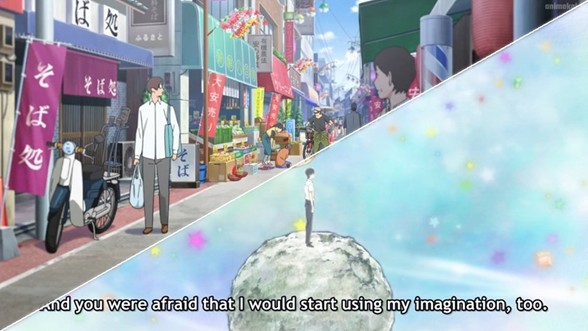
Figure 1: I Want to Eat Your Pancreas (Ushijima, 2018): photorealistic setting (top-left) contrasted with the dreamlike anagnorisis sequence (bottom-right), illustrating the film’s use of visuals to externalise Haruki’s emotional change.
Aristotle argues that tragedy produces catharsis, or ‘purification’ of the emotions of ‘pity and fear.’[10] The film achieves this in its final act. When Haruki finally visits Sakura’s mother and asks, ‘Can I cry now?’ it is permission sought not just by the character, but arguably by some of the audience. As Haruki breaks down into unrestrained sobbing, the audience also undergoes a collective catharsis. This release allows the audience to leave the film theatre with a lighter mood after having processed the fear of their mortality through the safety of the screen.
Ultimately, I believe that Aristotle would have ‘liked’ film as a medium despite having some misgivings about it. He was a philosopher who engaged in categorisation of tools to control the audience’s emotions, and film expands the tragedian’s toolset with new techniques while also not making obsolete the elements of tragedy which Aristotle set out. Even if he may be dismayed at the prominence which film gives to opsis/spectacle, many films like I Want to Eat Your Pancreas also heavily rely on the strength of their writing and plots. This proves that Aristotle’s ideas about tragedy still greatly inform the genre of tragedy today even if the weight given to each element in film may have shifted not necessarily in the direction which he may have thought appropriate.
Bibliography
Aristotle, Poetics, trans. by Malcolm Heath (Penguin, 1996)
I Want to Eat Your Pancreas (Kimi no Suizou wo Tabetai), dir. by Shin’ichirō Ushijima (Studio VOLN, 2018)
[1] Aristotle, Poetics, trans. by Malcolm Heath (London: Penguin, 1996), p. 12.
[2] Aristotle, p. 13.
[3] Aristotle, p. 16.
[4] Aristotle, p. 18.
[5] Aristotle, p. 21.
[6] Aristotle, p. 11.
[7] Aristotle, p. 18.
[8] Aristotle, p. 13.
[9] Aristotle, p. 22.
[10] Aristotle, p. 10.


